
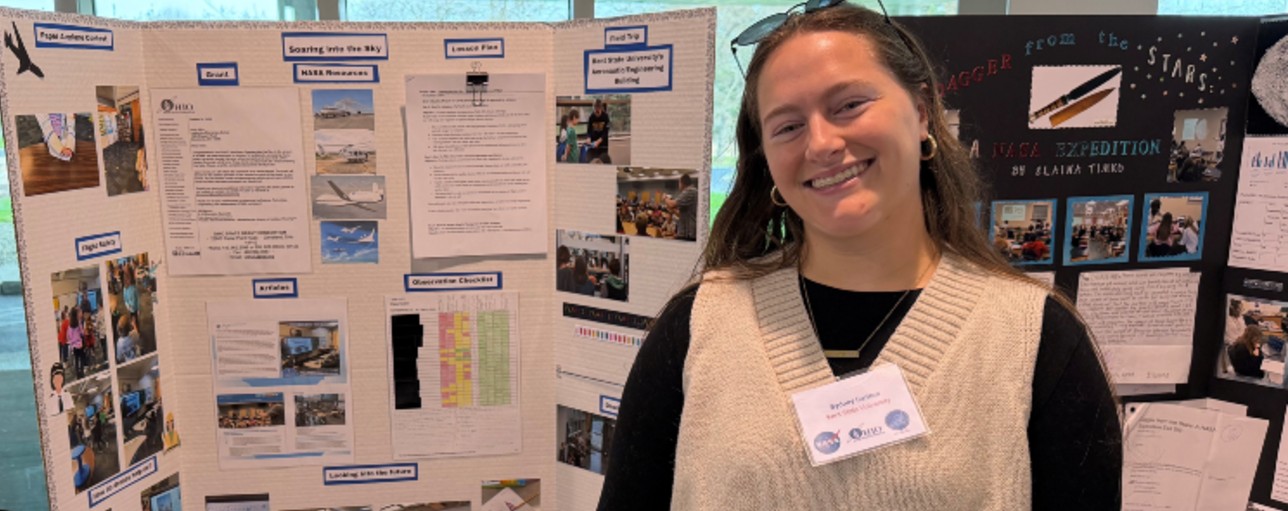
Sydney Carlton probably didn鈥檛 think that her time in Early Childhood Education would intersect with Ohio鈥檚 aerospace community鈥攂ut that鈥檚 exactly what happened when she presented her research at the annual Student Research Symposium.
Representing 91看片网 University, she joined more than a hundred student researchers from across Ohio, each presenting projects supported by NASA-aligned funding and mentorship. 91看片网 stood out with thirteen presenters, and among them, Carlton brought a unique perspective: the power of early STEM education.
A Better Flight Plan
As a preservice teacher in 91看片网鈥檚 nationally recognized Early Childhood Education program in the College of Education, Health and Human Services, Carlton has always believed that young learners are capable of high altitude thinking. Her project, Soaring into the Sky, proved just how far that belief could go.
Over four days, she guided nearly 100 second graders from Ledgeview Elementary School through an immersive STEM unit that blended aviation, aeronautics, and aerospace safety. Inspired by NASA research and designed to meet academic standards, the unit invited children to think like engineers, pilots, and innovators.
Students experimented with paper airplane aerodynamics, practiced communication in an air traffic control simulation, watched a drone demonstration, and even designed eco鈥慺riendly aircraft of the future. The lessons weren鈥檛 just hands-on, they were minds-on, encouraging collaboration, creativity, and critical thinking.
Introducing Early Learners to the NASA Pipeline
At the OSGC symposium, Carlton presented how early exposure to STEM鈥攅specially aerospace concepts鈥攃an spark curiosity that lasts well beyond elementary school. Her work aligned beautifully with OSGC鈥檚 mission: to strengthen the nation鈥檚 STEM workforce and inspire future scientists, engineers, and educators through NASA partnerships.
While many presenters focused on advanced research, Carlton highlighted something equally essential: the moment when a child first realizes that science is not just something to learn, but something to do. Her project demonstrated that the pipeline to aerospace careers doesn鈥檛 necessarily begin in high school or college鈥攊t can start with a paper airplane in a second-grade classroom.
A 91看片网 Story Worth Celebrating
91看片网鈥檚 membership in the Ohio Space Grant Consortium has opened doors for students across disciplines, and Carlton鈥檚 participation showcased the breadth of that impact. She represented not only the College of Education, Health and Human Services, but also the idea that STEM belongs to everyone鈥攅ven the youngest learners.
Her work reminds us that exploration starts early, inspiration is contagious, and sometimes the most important flights begin with small hands, big ideas, and a teacher who believes in both.